.
Liu formula student´s newsletter
Newsletter 5
Welcome back! In this month’s edition of the newsletter we take a closer look at two of the core technical teams that make our car fast, efficient, and reliable: Aerodynamics and Electronics.
Aerodynamics
The Aerodynamics team consists of around 20 members and is divided into two sub-groups: Design and Computational Fluid Dynamics simulations (CFD). The Design Team develops aerodynamic concepts in CAD using CDF to guide an iterative design process. They are also responsible for designing the mechanical components of the aero package and manufacturing parts in materials such as pre-preg carbon fibre.
The CFD sub-group focuses on maintaining and developing the team’s CFD methodology and works closely with the design team to support data-driven design decisions. In addition, the team includes a structural engineer who develops composite Finite Element Modeling (FEM) models to optimize laminate layups and ensure structural integrity.
As a team, Aerodynamics is responsible for designing, producing, and validating the complete aerodynamic package of the car. Their work has a direct impact on overall vehicle performance, and close collaboration with the Vehicle Dynamics and Chassis teams is essential to ensure that aerodynamic performance integrates seamlessly with the rest of the car. This year, the team has achieved major improvements in the front wing and the side aerodynamic components. By increasing stability across a wider range of operating conditions, they have made the car more predictable and consistent. One of the most intense periods for the team occurs in November and December, when designs must be finalized under tight internal and sponsor-related deadlines.
Electronics
The Electronics Team consists of approximately 15 members who work on different parts of the car’s electrical systems. Some focus on hardware development, such as designing custom circuit boards and building the wire harness, while others specialize in software for various vehicle systems. Together, they are responsible for all electrical systems on the car, including the high-voltage tractive system as well as low-voltage systems such as telemetry and safety systems.
The team collaborates mainly with the Packaging team, but also works closely with Aerodynamics and Vehicle Dynamics to ensure seamless system integration. One of the most critical components of the electrical system is the main high-voltage battery. Without it, the car would not be able to operate. It is essential to not only extract the required performance from the battery, but also to comply with strict safety regulations. For the Electronics Team, the most stressful period usually occurs during the spring testing phase. As systems are powered up and validated, unexpected issues inevitably arise, and solving them efficiently is crucial to keeping the ER26 project on schedule.
Together, Aerodynamics and Electronics make the car come to life, become efficient through the air and safe to drive. By collaborating with most of the teams in the organisation they ensure that performance, reliability, and safety are integrated into every stage of the development process. From early design concepts to final testing, their combined knowledge transforms simulations, calculations, and wiring diagrams into a functioning race car ready to compete.
LiU Formula Student – Where Students Become Professionals
Newsletter 1 - Management
LiU Formula Student – Management & Goals for the ER26 Project
Welcome to ER26’s first newsletter!
A new year brings a new car, new challenges, and a new management team. For this year’s LiU Formula Student project, ER26, we have a strong group of dedicated members who will combine technical expertise, leadership, and a shared passion for innovation. Here’s your chance to get to know the management team a little better. Who they are, why they joined the organization, and what they have learned along the way.
Isac Vejklint – President
Isac is pursuing a master’s degree in Sustainable Enterprise. He started in the Cost & Business team during the ER22 project, but now serves as the President of the organization. He describes Formula Student as the coolest student association at LiU and was drawn to the opportunity to be part of something that operates more like a real company than a traditional student association. Through his involvement, Isac has gained valuable insight into how large organizations function and how leadership can foster structure, engagement, and motivation within a team. His role has deepened his understanding of what effective leadership means and how to build a strong, goal-oriented culture where everyone contributes to a shared goal.
Gustav Johansson – Vice President
Gustav is studying for a master’s degree in Computer Engineering and Digital Business Development. Gustav serves as the Vice President, but began his journey in the Cost & Business team during the ER23 project. He finds it incredibly exciting to be part of a large-scale project that functions more like a professional organization than a student association. During his time in Formula Student, Gustav has learned how to manage his time effectively, work within complex project structures, and to understand how both technical and organizational systems interact. His background in technology has sparked a particular interest in the digital and software aspects of the project, and he is passionate about bridging the gap between engineering and management.
Simon Jönsson – Treasurer
Simon is pursuing a master’s degree in Logistics and Supply Chain Management. He joined during the ER25 project and is the organisation’s Treasurer. He initially joined Formula Student because several of his friends were involved and he wanted to spend his free time doing something fun and meaningful. Over time, Simon has gained a deep understanding of how large projects are organized, how to plan and execute complex tasks, and how teamwork makes it possible to overcome difficult challenges. As Treasurer, he has developed valuable skills in project management, financial responsibility, and communication. All of which complement the theoretical knowledge from his studies.
Victor Fräjdin – Technical Director
Victor holds a bachelor’s in Mechanical Engineering and is currently doing his master in Applied Mechanics. He began his Formula Student journey in the Mechanical Powertrain team during the ER23 project where he helped design the battery enclosure. He joined the project because he wanted to apply his academic knowledge in a hands-on engineering environment. Now, as Technical Director, Victor oversees the technical development of the car and ensures that all systems work seamlessly together. His time in the organization has taught him a great deal about practical engineering, managing large technical projects, and how communication between teams is essential for success.
Viktor Hedvall – Chief Engineer
Viktor is a Mechanical Engineering graduate and is currently pursuing his master’s in Applied Mechanics and currently serves as Chief Engineer. He began his involvement in the Vehicle Dynamics team during the ER23 project working on designing the pedal box. He describes the experience of building a real race car as both challenging and rewarding. Through his work, Viktor has learned extensively about product development – from the initial concept to the finished parts installed in the car. His role has also given him valuable experience in leading technical teams, making data-driven design decisions and making continuous improvement throughout the project.
This Year’s Project – ER26
The ER26 car features a mid-mounted single motor with a limited slip differential and a brand-new battery pack. This year’s focus is on thorough documentation, rigorous testing, and continuous incremental improvements. All aimed at creating a car that is not only fast, but also reliable and meticulously engineered. If you want to learn more about the ER26 project, you can find information about the competitions and the car on our website.
Our main goals for the ER26 season are:
- To complete all dynamic and static events with full functionality.
- To achieve at least 400 points in one competition.
- To ensure every event is tested and verified at least twice before competing.
LiU Formula Student is more than just a technical project – it’s a place where students become professionals. With a strong leadership team and clear goals, we look forward to a year filled with learning, teamwork, and good times.
This was all for the first newsletter of the project, and we hope to see you in the next one where we will follow more of the technical teams during their progress working on the ER26 car.
LiU Formula Student – Where students become professionals.
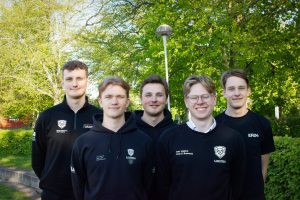
From the left: Gustav, Viktor, Victor, Isac, Simon
Newsletter 2 - Chassi & Vechical Dynamics
Second Newsletter for the ER26 project
Welcome to the second edition of the ER26’s newsletter! In this letter we will cover the engineering teams Chassis and Vehicle Dynamics. Two teams that are very important for the car’s main structure and functionality. Continue reading and you will learn what their main responsibilities are and how they work together to make sure that the project runs smoothly.
Chassis – The Backbone of the Car
Every Formula Student car needs a strong and well-engineered skeleton, the chassi, to function. It’s the structure that holds the entire car together physically. This project, our Chassis Team is exploring new design solutions to decrease the weight and start implementing carbon fiber instead of only steel tubes, like previous years.
The Chassis Team consists of ten dedicated members, divided into two main groups: the frame and the driver’s environment. In addition, one member focuses on composite development and another on structural calculations. Together, the team is responsible for designing and manufacturing the car’s chassis. A process that needs to be finished early in the car’s development since other teams depend on it.
Their work covers everything from the load-bearing steel space frame to the driver’s environment, which includes the seat, headrest, steering wheel, and related safety systems. Because the chassis endures significant forces during racing, each component must undergo thorough verification. This involves extensive manual calculations and simulation analyses, ensuring every part achieves the perfect balance between low weight and maximum strength.
Material selection is critical for both performance and safety. The frame is primarily made from steel tubes, complemented by steel and aluminum sheet components. Within the driver’s environment, several parts are made from carbon fiber composites. Safety systems, which must comply with Formula Student regulations, are sourced externally.
Thanks to strong partnerships with our sponsors, the chassis tubes we get from ME racing are laser-cut by Luni and bent by BS Rörbock, before being TIG-welded together in the university’s workshop. Most other parts are also produced in-house from water-cut and bent sheet metal to MDF molds for carbon fiber manufacturing. All composite production takes place in LiU’s composite lab, handled directly by the team.
Time management is a critical aspect for the Chassis Team. As one of the first components that must be completed, the chassis sets the pace for the entire production phase. The goal is to finalize all frame design work, including the welding jig, by early December, followed by the rest of the chassis design in mid-December.
The biggest innovation this year is the introduction of carbon fiber panels replacing certain steel tubes. This marks an important step in the team’s long-term vision of transitioning to a monocoque chassis, where the chassis and bodywork form a single integrated structure. While this shift introduces new challenges in testing and validation, it also promises progress in weight reduction and structural stiffness.
Vehicle Dynamics – Bringing the Car to Life
The Vehicle Dynamics Team is responsible for all the moving components of the car – the systems that allow it to accelerate, brake, and steer. They define the car’s dynamic behavior through simulations and iterative design work, ensuring that it’s drivable.
The team consists of 17 engineers working on complex mechanical systems such as suspension, steering, drivetrain, and brakes. Some members focus more on simulations and analysis, studying how tire and suspension parameters affect overall vehicle performance to refine the car’s behavior.
For the ER26`s project, the goal is to build a car with improved reliability and performance through data-driven design. One of the team’s most important milestones is determining the suspension pick-up points, which have a major impact on the entire vehicle’s dynamics. During spring, the team also lead the Rolling Chassis milestones, the exciting moment when all systems are installed, and the car rolls and steers for the first time.
Collaboration is essential for the Vehicle Dynamics Team. Almost every system they develop interacts with other teams, requiring clear communication and teamwork. For instance, the suspension system directly affects the Chassis Team, while the drivetrain requires close coordination with the Packaging Team.
A major focus this year for the team is improving how simulation tools, physical testing, and validation are used together. By analyzing real data from tests and simulations, the team aims to make more informed, data-driven engineering decisions that enhance the car’s reliability and performance.
Together, the Chassis and Vehicle Dynamics teams form the foundation of our Formula Student car by combining engineering precision, teamwork, and testing new solutions to improve the reliability and performance of the car.
LiU Formula Student – where students become proffessionals.
Newsletter 3 - Marketing, Sponsorship & Internal Systems
Newsletter 3
Welcome back to the third newsletter of the ER26 project! It´s past Christmas time and we have a late treat to you, a newsletter about our non-technical teams Marketing, Sponsorship and Internal systems. These teams act behind the scenes so the organisation gets seen and runs smoothly. Compared to our teams that develop the car and now you get to learn more about them!
Marketing
The Marketing Team is responsible for how the organisation is presented, both internally and externally. Through communication, branding, and events, the team helps show what the association does and why it matters.
The team consists of 8 people that work with different tasks, such as graphic design, social media, events, and merchandise. They make sure that LiU Formula Student has a clear and consistent presence across all platforms. A big part of their work is to explain the technical work in a way that is easy to understand and interesting to follow.
Marketing is important for the whole organisation. Good communication helps attract sponsors, engage students, and highlight the effort that all teams put into the project. The marketing team connects the technical work with the people who follow and support LiU Formula Student.
The team is also responsible for several major events. One of the biggest is the Roll Out, where the car and the new season are presented. They also plan internal events like the Christmas sitting and the cycling parties, which help strengthen the community within the association.
There is a close collaboration with the Sponsorship Team. Together, they make sure that partners are presented in a professional way and that collaborations are visible and valuable. This is important for building strong and long term relationships with sponsors. The team also works closely with the technical teams. By staying in contact with the engineers, they can share updates, milestones, and progress in a correct and honest way. This helps ensure that the story of the car reflects the real work behind it.
In the long term, the goal for marketing is to continue building and strengthening the LiU Formula Student brand and increasing the amount of engagement in our social media channels. By being clear, consistent, and active, the team aims to increase visibility and make the association attractive both inside and outside the university.
Sponsorship
The Sponsorship team consists of six members, each responsible for securing sponsors for one or more teams within the organisation. The work typically begins with an initial email where they introduce ourselves and propose a meeting, either digitally, in person, or through continued email contact. They primarily approach companies whose products or services align with our needs in the project, while also considering partnerships that offer mutual benefit. A key requirement for any sponsor is alignment with our ethical values.
When presenting LiU Formula Student, they highlight that we are a student-run organisation working together toward a common goal, to learn and perform well in competition at the end of the season. They are seeking long term partnerships where both parties benefit from the collaboration. Sponsors gain advertising opportunities and direct contact with students at Linköping University. Our sponsor portfolio is diverse, with a strong focus on technical companies providing essential products and services, complemented by non technical sponsors who are equally important.
Sponsors primarily support us through products and services that are crucial to completing the project. While teams have different budgets and needs, every sponsor plays an equally important role in making the project possible. The attractiveness to sponsors lies in the direct connection we offer to future engineers and economists through activities such as events, lunch lectures and company visits, as well as brand exposure on our website and on the car as it competes across Europe.
The Sponsorship team collaborates with all teams by securing sponsorships that support their progress and maintain close communication with the technical teams to address challenges. Together with the Marketing team, they ensure our sponsors are highlighted through social media and ongoing updates. Long term partnerships are built through trust, transparency and fulfilled agreements. Every sponsor joining our journey is valued, but we continue to aim high, with dream partners such as SpaceX or Kongsberg, all while keeping the team spirit alive with our anthem, Schnappi das kleine Krokodil.
Internal systems
The Internal Systems team consists of four members responsible for creating and maintaining internal web tools. These tools are designed to make other teams’ workflows faster, easier, and more efficient, allowing them to focus more time on working on the car and developing their skills.
The team are currently developing several core systems, including the BOM (Bill of Materials), the TDHS (Test Data Handling System), and a unified authentication solution shared across all internal web tools. The technical stack primarily consists of React using the JavaScript framework for the frontend, a Python-based backend, and Docker to organize and manage our applications and automation scripts.
Internal systems work plays a critical role in improving the organisation’s efficiency. With a fixed amount of time to build the best car possible, streamlined workflows are essential. They design our systems to be intuitive and easy to understand, especially for new members, so they can onboard quickly and feel comfortable with the organisation’s workflows.
Looking ahead, the goal is to create a cohesive system used across all teams, where information is easy to access, well-structured, and simple to find. We aim to establish a clear philosophy for all internal systems, supported by documentation, guides, and shared knowledge in a centralised location. In doing so they hope to significantly improve the experience on the administrative side of the organisation while also adding fun easter eggs for everyone to enjoy.
Because the mission is to support all teams, collaboration and clear communication are central to how we work. Depending on the project the internal systems team collaborates more closely with certain teams, but our focus remains on understanding their needs and improving their workflows.
As a newly created team within the organisation, the early work is especially important, as it sets the standard and foundation for all web tools we will create going forward.
That´s all from our non-technical teams and as you may understand they work a bit more behind the scenes, but are equally important to the organisation.
LiU Formula Student – Where students become proffessionals
Newsletter 4 - Production & Packaging
Newsletter 4
This month, we want to shine a spotlight on two teams that play a crucial role in turning ideas into reality: The Production and Packaging Team. Together, they ensure that our designs don’t just look good in CAD, they can actually be built, assembled, and perform reliably on track.
Production
The Production Team is responsible for making sure that the car can physically be manufactured. Acting as the bridge between our technical design teams and real-world production. The team works closely with the LiU workshop, which is one of our most vital resources. From managing materials, fasteners, tools, and 3D printers to reviewing hundreds of technical drawings, Production ensures that every component is designed with manufacturing in mind.
A major new responsibility for the team this year is the Cost & Manufacturing event. This means that Production is not only focused on how parts are built, but also on calculating their cost and the carbon emissions generated during production through Life Cycle Assessment. With a team of nine members, the work is divided between Production Engineers, who collaborate directly with technical teams on manufacturability, and Cost & Emissions Analysts, who compile the Costed Carbonized Bill of Material and optimize our performance in this key competition event.
The most intense period for the Production Team is the production phase between January and March. Especially challenging are the weeks right after the Christmas break, when all production documentation must be finalized and reviewed. To help reviewing all the documents Production uses AI-driven examination from T&S Engineering. The device makes sure all the drawings are up to standard and also help to streamline the design process. Thanks to T&S Engineering the Production team can focus more on innovation and practical teamwork. Despite the pressure to finalize everything, there’s nothing more rewarding than seeing CAD models transform into physical, functioning parts, a moment every system engineer looks forward to.
Packaging
Equally essential is the Packaging Team, whose mission is to ensure that all systems fit together seamlessly inside the car. The Packaging Team focuses not only on technical progress but also on team development and collaboration. Creating an inclusive and supportive environment is a key priority, making sure every member feels confident and integrated into the organization.
The team consists of 12 members and is divided into four subteams: Battery Container, Cooling System, Brake Lines, and Electronics Packaging. Their responsibility is to design and construct all mechanical parts related to electronics and system integration, ensuring that everything is lightweight, compact, watertight, and precisely packaged. Because of this, precision is absolutely critical. When space is limited, every millimeter matters.
Packaging collaborates closely with all technical teams, but especially with the Chassis Team, where alignment and communication are vital. The most stressful period occurs at the end of the design phase at the beginning of the year, when final design decisions are made before parts are sent to production.
And finally, a highlight no one should miss: the legendary yearly beer testing event, where the members of the organisation test different beers and the winning brew earns the honor of becoming this year’s cooling system catch can.
Together, Production and Packaging are key to transforming theory into reality and ensuring that our car is not only fast and innovative, but also buildable, reliable, and competition-ready.
LiU Formula Student – Where Students Become Professionals

AbOUT US
We are a student-run organization based in Linköping, Sweden, dedicated to designing and building a Formula Student car each year. After completing the car, we compete against other Formula Student teams from around the world.
Social Media
Hosted by